How to Price Your Freelance Work: A Simple Formula for Hourly and Project Rates
Stop guessing your rates. A clear, step-by-step way to set an hourly rate that covers your costs — with a free calculator and worked examples.

On this page
- Step 1: Decide what you need to earn in a year
- Step 2: Count your real billable hours
- Step 3: Work out your minimum hourly rate
- Step 4: Turn your hourly rate into a project price
- Step 5: Check the price against the market
- Step 6: Raise your rates on a schedule
- Common pricing mistakes to avoid
- How Noveo helps you price with real numbers
Most freelancers set their price by looking at what others charge, then going a little lower to be safe. It feels reasonable, but it often leads to long weeks, tired evenings and very little money left at the end of the month. A better way is to start from your own numbers and work forward. It takes about twenty minutes, and you only have to do it properly once.
Below you will find the six steps, two worked examples and a free calculator you can use right on this page.
Step 1: Decide what you need to earn in a year
Start with the yearly income you want to take home. Then add everything your business has to pay before that money reaches you:
- Software and subscriptions (design tools, hosting, cloud storage, AI tools)
- Equipment you will need to replace, like a laptop or phone
- Internet, workspace and phone bills
- Platform and payment fees
- Taxes you set aside for your country
- Savings for slow months, holidays and sick days
The total is the amount your work must bring in every year. This is your target revenue.
Step 2: Count your real billable hours
This is where most freelancers make the biggest mistake. A year has around 2,000 working hours, but you cannot bill all of them. A good part of your week goes to emails, sales calls, proposals, invoices, learning and fixing your own tools.
Track one normal week honestly. Many people find that only half to two thirds of their working time is spent on paid client work. Use your own figure, then remove holidays and public holidays. What is left is your number of billable hours per year.
Step 3: Work out your minimum hourly rate
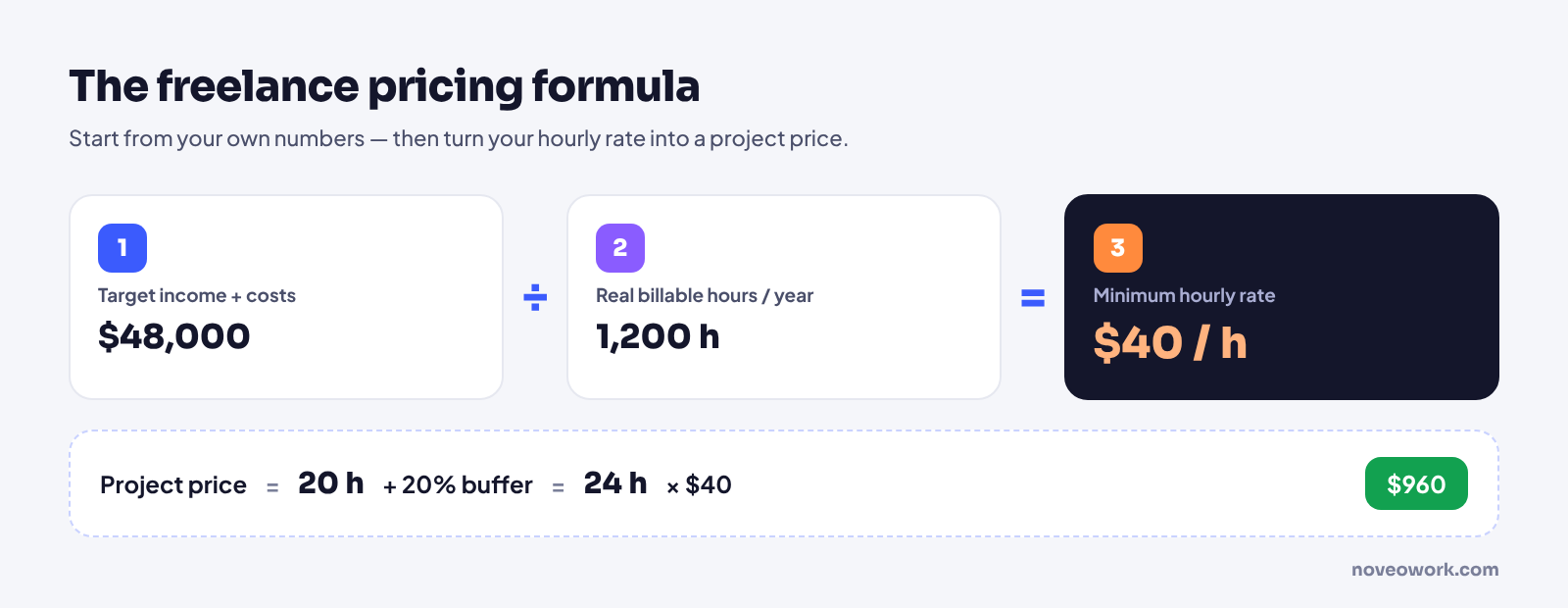
Divide your target revenue by your billable hours. That is the lowest hourly rate at which your business works. Anything below it means you are paying to do client work.
Example: If your target revenue is $48,000 a year and you have 1,200 billable hours, your minimum rate is $48,000 ÷ 1,200 = $40 an hour.
Want to try it with your own numbers? Use the calculator:
Your minimum is the floor, not your price. Add more for experience, speed and specialist skills.
Your minimum is not your price. It is the floor. Experience, specialist skills, fast delivery and great reviews are all reasons to charge more than the minimum.
Step 4: Turn your hourly rate into a project price
Clients usually prefer one clear price for the whole job. To build it:
- Break the project into steps: research, first draft, revisions, final files, calls.
- Estimate the hours for each step, based on similar work you have done.
- Add a buffer of 15–25% for the things nobody plans for: extra emails, small changes, waiting for feedback.
- Multiply the total hours by your hourly rate.
Example: A landing page needs 4 hours of planning, 10 hours of design, 4 hours of revisions and 2 hours of calls and handover: 20 hours. With a 20% buffer that is 24 hours. At $40 an hour, the project price is $960.
| Step | Hours |
|---|---|
| Planning | 4 |
| Design | 10 |
| Revisions (2 rounds) | 4 |
| Calls and handover | 2 |
| Buffer (20%) | 4 |
| Total × $40 | $960 |
Write the number of revision rounds into your proposal. Unlimited revisions quietly destroy project prices.
Step 5: Check the price against the market
Now look at what others charge for similar work. If your price is far above the market, look at what you can offer to justify it: a narrower niche, faster delivery, a stronger portfolio, or a package that includes more. If your price is below the market, you have just found free money — raise it.
Step 6: Raise your rates on a schedule
Review your rates every six months. Raise them for new clients first, and give existing clients a month’s notice with a simple message: what changes, from when, and a thank-you for working together. Most good clients expect prices to grow as your skills grow.
Common pricing mistakes to avoid
- Pricing by time instead of value. If your work saves or earns a client a lot of money, your price can reflect that.
- Forgetting platform fees. If a platform takes a share of every order, build it into your price.
- Ignoring currency. When clients pay in USD, EUR or GBP, the amount that reaches you changes with exchange rates and transfer fees.
- Never checking the real result. A project quoted at $960 that took 40 hours actually paid you $24 an hour.
How Noveo helps you price with real numbers
Pricing gets much easier when you stop guessing and look at your own data. In Noveo you can track time on every project, so you see exactly how many hours a job really took and what you earned per hour. Your payments, platform fees and expenses sit in one money overview, totalled in your own currency even when clients pay in USD, EUR or GBP. And when the price is agreed, you can send a professional invoice with a private link and automatic reminders.
Set your rate once with the steps above, then let your own numbers tell you when it is time to raise it.
Frequently asked questions
Should I charge hourly or per project?
Use your hourly rate to calculate, but quote clients a project price when the work is clear. Clients like knowing the total, and you earn more when you work faster. Hourly billing suits open-ended work like ongoing support.
How many billable hours does a freelancer have in a year?
It depends on you. Many freelancers bill only half to two thirds of their working hours, because sales, emails and admin take the rest. Track one normal week to find your own number.
What if my calculated rate is higher than the market?
Look for ways to give more value: a narrower niche, faster delivery, better results or a package. If you cannot, cut costs or work on skills that let you charge more. Charging below your minimum is not sustainable.
How often should I raise my rates?
Review them every six months. Raise prices for new clients first and give existing clients about a month’s notice.
Clients, projects, time, invoices and money — free to start.
Try Noveo free